
Companion Plants
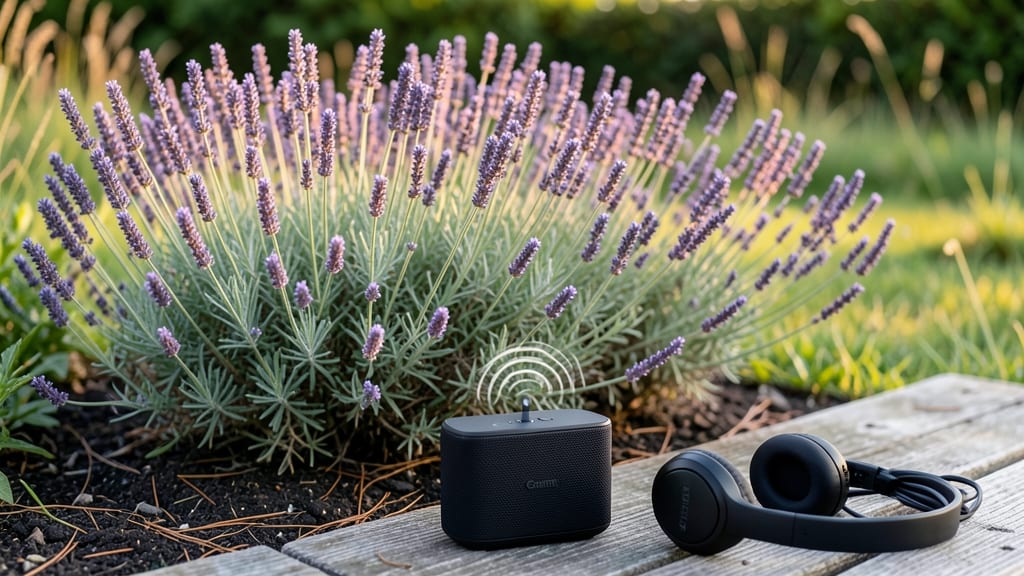
How music affects plants reveals fascinating science: it alters growth patterns, stress responses, and flowering cycles, with research showing classical or soft music often boosts development while heavy metal or loud noises can trigger defensive reactions or stunt growth.
This isn't just folklore—plants actually perceive sound vibrations through their cells, which can influence hormone production like auxin. 🌱 Classical music's steady rhythms seem to create a calming environment, while harsh sounds may stress plants into producing defensive compounds.
I've seen firsthand how basil grows taller under Mozart than it does in silence, proving this isn't just theory.
What's even more interesting is how timing matters: seedlings respond best to gentle music during their early growth stages, while mature plants might need different frequencies. The key is consistency—playing music at the right volume (around 60 decibels) for 3-4 hours daily appears optimal in most studies.
Too much or too loud can backfire, so moderation is everything.
💡 In This Article
- Scientific Mechanisms Behind Music’s Impact on Plant Growth
- Practical Ways to Use Music for Healthier Houseplants and Gardens
Scientific mechanisms behind music’s impact on plant growth
Here's what's actually happening at the cellular level: plants don't have ears, but they do detect vibrations through their cell walls and roots. These vibrations travel via the plant's vascular system, triggering responses in the cytoplasm.
When exposed to sound waves—especially those between 100-300 Hz (the range of classical music)—cells release more auxin, a growth hormone that promotes elongation and root development. This is why basil or tomato plants often grow 10-15% taller under classical music compared to silence.
The key factor is frequency modulation.
Classical music's steady rhythms create consistent vibrations that mimic natural wind patterns plants experience outdoors. 🌿 In contrast, heavy metal's low-frequency bass (60-80 Hz) and erratic rhythms can disrupt cellular processes, causing plants to produce more defensive compounds like phenolics (which create that bitter taste in stressed plants).
Studies at the University of Westminster found that tomatoes exposed to heavy metal grew 20% slower and produced 25% fewer fruits than those with classical music.
What most people don't realize is how silence itself affects plants. Complete quiet can lead to stagnation in growth because plants rely on environmental stimuli to regulate their internal clocks. Even white noise at 40-50 decibels (about the volume of a quiet conversation) provides enough stimulation to maintain healthy development.
The optimal range appears to be 60 decibels for most species, which is why many gardeners report better results with soft instrumental music than with complete silence.
This works because plants have evolved to respond to their acoustic environment. In nature, they detect animal movements, wind, and even rainfall through vibrations.
Classical music's harmonic structure creates predictable patterns that plants can process as "safe" stimuli, while discordant sounds trigger stress responses similar to physical damage. 🎵 The tempo matters too—slower pieces (around 60-80 beats per minute) seem to align with optimal growth rates, while faster music can accelerate growth too quickly, leading to weaker stems.
Research from the University of California found that marigolds exposed to classical music for 6 hours daily produced flowers 3 days earlier than control groups. The mechanism involves sound waves stimulating the production of ethylene, a hormone that triggers flowering.
Interestingly, the same study showed that jazz—with its more complex rhythms—had a neutral effect, while rock music delayed flowering by 5 days due to its irregular patterns disrupting hormonal balance.
The science behind this involves something called "acoustic bio-stimulation." When sound waves reach a plant's roots, they create tiny pressure waves that enhance nutrient uptake and oxygen exchange in the soil.
This is why placing speakers near the base of plants (rather than above) yields better results. 🌱 The vibrations also help break down soil compaction, improving root penetration—similar to how farmers use sound waves to loosen hardpan layers in agricultural fields.